
Table of Contents
- Why Hand-Drawn Nursery Wall Art Matters
- How to Choose the Right Hand-Drawn Designs for Your Space
- Creating Nursery Gallery Wall Ideas That Work
- Personalised Nursery Wall Art: Adding Your Child's Story
- Digital Nursery Prints vs. Printed Options
- Building a Nursery Print Set for Cohesion
- Materials, Care, and Safety Considerations
- Frequently Asked Questions
Last Updated: October 12, 2026
Why Hand-Drawn Nursery Wall Art Matters
Hand-drawn nursery wall art transforms a room from functional to meaningful. When you shop hand drawn nursery wall art, you're creating a space that reflects your child's personality and your family's story.
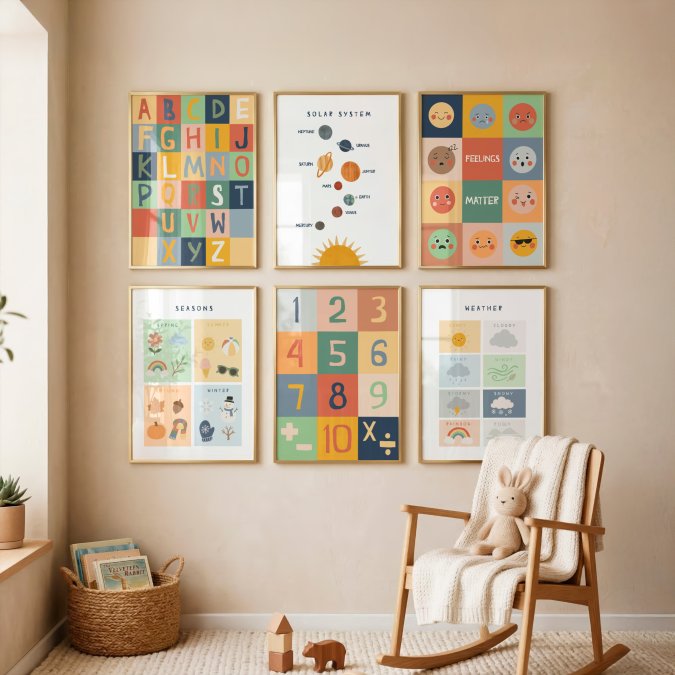
The difference between mass-produced prints and hand-drawn designs is immediately visible.
There's also a practical benefit: hand-drawn designs age beautifully. A whimsical animal illustration doesn't feel dated when your toddler turns three, so the nursery evolves into a big-kid bedroom without an overhaul.
How to Choose the Right Hand-Drawn Designs for Your Space
Choosing nursery wall art isn't about picking the prettiest print. It's about matching the design to your room, your aesthetic, and your child's evolving needs.
Consider Your Nursery Theme and Colour Palette
Your colour palette is the foundation of every design choice. Hand-drawn designs work best when they complement, not compete with, your room's colours.
Look at what's already in your space: the cot bedding, curtains, and furniture. If your nursery leans boho, celestial prints like the Sun, Moon & Star design work beautifully; for coastal or playful themes, animal prints bring personality without overwhelming the space.

Consider whether you want your art to be the focal point or a supporting player.
Think About Longevity and Growing With Your Child
This is where hand-drawn designs truly shine. A whimsical giraffe or playful crocodile doesn't scream "baby" the way cutesy imagery does.

Hand-drawn work has a timelessness that mass-produced nursery prints lack. A child who grows up with intentional art develops an eye for design, and the prints you choose now become part of their visual memory.
Choose themes that age well: animals with personality, celestial imagery, nature-inspired designs, and abstract patterns. Avoid cutesy or baby-specific text, and pick pieces your child might keep on their wall as they get older.
Creating Nursery Gallery Wall Ideas That Work
A gallery wall transforms hand-drawn nursery prints into a cohesive visual story. The key is planning before you buy: most shoppers buy frames first and then discover the wall doesn't fit them.
Plan Your Layout Before You Buy
Sketch your layout on paper or with a free digital tool before buying frames. Measure your wall, then subtract space taken by furniture, light switches, and power points, what's left is your usable zone.
Three layout patterns cover almost every nursery:
- Tight grid. Same-sized frames, same mat colour, equal spacing in rows and columns. Best for three, four, six, or nine prints. Feels calm and ordered.
- Salon-style mixed. Different frame sizes arranged around a central anchor piece. Best for five to eight prints. Feels collected and layered.
- Loose scatter. Three to five pieces spaced widely, often at different heights. Best for large walls where you want breathing room rather than density.
For tight grids, keep frames, mats, and spacing consistent. Mixed layouts allow more flexibility as long as you maintain visual balance, and the hand-drawn designs should feel related even if they're different animals or themes.
Consider negative space carefully. Three or five pieces arranged thoughtfully create more impact than eight crammed together, hand-drawn nursery wall art deserves breathing room.
Sizing and Spacing Guidelines
Standard print sizes are A4 (210 × 297 mm), A3 (297 × 420 mm), and A2 (420 × 594 mm).
Keep spacing consistent: 5-10 centimetres between frames looks intentional. Tighter spacing groups pieces; wider spacing makes each feel independent. In a mixed-size wall, let smaller pieces guide spacing to avoid awkward gaps.
Hanging height is where most nurseries go wrong. Centre the arrangement at roughly 145-150 cm from the floor, lower than the 150-160 cm for adult living rooms, since you'll view it from a change table or feeding chair.
A few practical checks before you drill:
- Cut paper templates to the exact frame sizes and tape them to the wall for a day. You'll spot problems you can't see on a sketch.
- Mark picture-hook positions on the templates, then transfer them to the wall.
- Use two hooks per frame for anything wider than 40 cm so it can't tilt.
- Check for studs, and for plasterboard walls use hollow-wall anchors rated well above the frame's weight.
Choosing Frames and Mounts That Suit Hand-Drawn Work
Hand-drawn illustrations have fine linework and soft colour transitions, so the frame shouldn't compete. Light timber, white, and thin black frames recede and let the artwork lead; heavy ornate frames fight the delicacy of hand-drawn linework.
Mat boards matter more than most shoppers expect. A 5-8 cm mat around an A4 or A3 print gives the artwork visual space.
If you're framing yourself, look for frames with acid-free backing boards and a hanging kit included.
Personalised Nursery Wall Art: Adding Your Child's Story
Personalisation transforms hand-drawn nursery wall art from decoration into keepsake.
Custom hand-drawn pieces let you add details that matter: your child's name, birth weight and length, arrival time, or a meaningful date.
Surf Koala | Nursery Art Print →
Personalised nursery wall art also solves gift-giving: a grandparent or friend can commission a custom piece that feels thoughtful and specific.
Your child grows up knowing their nursery was designed specifically for them, and years later that print becomes a cherished memory of their earliest room.
Digital Nursery Prints vs. Printed Options
The choice between digital downloads and professionally printed pieces affects both cost and longevity.
Digital nursery prints offer flexibility and affordability: download the file, print it at a local printer or photo lab, and frame it.
Professionally printed hand-drawn nursery wall art arrives ready to frame, with vibrant colours, consistent paper quality, and a finish optimised for the design.
For parents who want to shop hand drawn nursery wall art without printing logistics, professionally printed options remove a step and guarantee quality.
Building a Nursery Print Set for Cohesion
A coordinated set of hand-drawn prints creates visual harmony, a curated collection feels intentional and complete rather than random.
When you shop hand drawn nursery wall art as a set, the designs already work together, sharing a consistent artistic style, colour palette, and thematic thread.
Sets make it easier to build a cohesive gallery wall over time.
Consider the Surf Koala, Whimsical Giraffe, and Confetti Crocodile prints as a coordinated collection. Each features a different animal, rendered in hand-drawn style, with complementary colour palettes.

Materials, Care, and Safety Considerations
When you shop hand drawn nursery wall art, understanding the materials ensures your investment lasts and your child stays safe, the difference between a print that looks good in year one and one that still looks good in year ten.
Paper, Ink, and Finish
Hand-drawn nursery prints should be printed on acid-free, archival-quality paper, since acidic paper yellows and becomes brittle over time. Look for at least 200 gsm, anything lighter feels flimsy and can ripple inside a frame.
Ink matters as much as paper. Pigment-based inks resist fading far better than dye-based inks, which is why archival giclée printing is the standard for fine-art reproductions. If a listing doesn't state its ink or printing method, it's usually a standard commercial run rather than an archival one.
Finish is a style decision with practical consequences:
- Matte. No glare, warm and soft, best for nurseries and for hand-drawn linework. Slightly more prone to showing fingerprints.
- Satin. A middle ground, low sheen, good colour depth, more forgiving of handling.
- Glossy. Vivid colours but reflects light and can feel harsh in a calm space. Generally best avoided in nurseries.
Framing for Longevity
Framing matters for longevity. Use UV-protective glass or acrylic to slow fading. Acrylic is lighter and safer than glass in a child's room because it's far less likely to shatter if a frame comes down; glass gives slightly crisper clarity but carries real risk.
Avoid direct sunlight. Position your gallery wall away from harsh afternoon sun, or use an interior wall or sheer curtains to diffuse light. Even with UV glazing, a print in direct sun for hours a day fades faster than one in indirect light.
Safety in a Nursery
Safety deserves the most care, and it's largely absent from product listings.
- Mounting. Fix every frame with wall anchors rated for at least twice the weight of the framed piece. Use hollow-wall anchors on plasterboard and masonry plugs on brick. Never rely on a single small nail for anything wider than about 30 cm.
- Hanging hardware. Use two hooks per frame for anything wider than 40 cm so it can't tilt or swing. D-rings with picture wire suit light frames; heavier pieces need a direct-to-wall bracket or two-point fixing.
- Placement. Keep frames out of reach of a cot and never hang anything directly above it, where a toddler could reach up or a frame could fall into the sleep space. Keep art at least 60 cm from the cot's edge.
- Climbing risk. Don't place a change table, chair, or storage unit beneath a gallery wall if a child could climb it to reach the frames. Keep the area below the wall clear.
- Frame edges. Avoid frames with sharp corners or small detachable parts. Rounded or bevelled frames are gentler if a child does bump into them.
Cleaning and Storage
Clean prints gently with a soft, dry microfibre cloth. Avoid moisture and harsh chemicals. Never spray cleaner directly onto a framed print, spray the cloth, wipe the frame only, and keep liquid away from the glazing edge where it can seep in.
For unframed prints, store them flat between acid-free tissue or in an archival folder, away from heat, damp, and direct light. Don't roll prints tightly, creases in heavy matte paper are hard to remove.
Frequently Asked Questions
How do I know if hand-drawn nursery wall art will actually suit my room style?
Hand-drawn designs work across many styles because they blend warmth with flexibility. Whether your nursery is boho, minimalist, or playful, the key is matching the colour palette and theme to your existing decor. Look for designs that echo colours you've already chosen for furniture or soft furnishings. Many artists, including Little Lemons Art, offer a range of themes—from woodland animals to celestial motifs—so you can find pieces that complement your aesthetic. Start with one print to test how it feels in your space before committing to a full gallery wall.
Will nursery wall art look babyish when my child grows into a toddler or older?
Hand-drawn artwork designed thoughtfully can grow with your child if you choose timeless themes and avoid overly cutesy styles. Animal prints, celestial designs, and botanical illustrations tend to age well because they appeal to older children and even teenagers. Personalised prints with birth details remain sentimental keepsakes rather than looking dated. Many parents find that shifting the frame style or rearranging the gallery wall as their child grows keeps the space feeling fresh without replacing the art itself. This is why choosing quality hand-drawn pieces from the start pays off.
What's the difference between digital nursery prints and printed versions?
Digital prints are downloadable files you print yourself at home or a local print shop, offering flexibility and lower upfront cost. Printed versions arrive ready to frame, printed on quality materials like premium matte paper that highlight hand-drawn details. Printed options save time and ensure professional colour accuracy, which matters for hand-drawn work where subtle tones matter. Digital prints work well if you're budget-conscious or want to experiment before framing. Little Lemons Art offers both, so you can choose based on your timeline and preference.
How long does a custom hand-drawn nursery art order typically take?
Custom orders vary depending on the artist's workload and the complexity of your design request. It's essential to check turnaround times before ordering, especially if you have a deadline like a baby's arrival. If you're due soon, starting with existing hand-drawn designs from a curated collection is a reliable way to get beautiful art on your walls quickly, then adding personalised pieces later.