
Table of Contents
- What Makes Nursery Wall Decor Montessori Inspired
- Developmentally Appropriate Nursery Art at Every Stage
- Why Low Hanging Nursery Art Builds Independence
- How to Create a Gallery Wall for Kids
- Choosing Materials, Colours and Themes
- Caring for Wall Art: Cleaning, Rotation and Long-Term Adaptability
- Budget-Friendly Ideas: DIY, Printables and Personalised Keepsakes
- Frequently Asked Questions
Last Updated: September 23, 2026
What Makes Nursery Wall Decor Montessori Inspired
Montessori inspired nursery wall decor is wall art chosen and positioned so a child can see it, reach it, and learn from it, rather than art chosen to fill space above a cot, and this guide treats montessori inspired nursery wall decor as a practical tool rather than decoration. This guide from Little Lemons Art breaks down how to choose pieces that support your child's development, from the first high-contrast weeks through the toddler years.
Developmentally Appropriate Nursery Art at Every Stage
Developmentally appropriate nursery art is imagery matched to what your child's brain can process right now. Most guides stop at "high contrast for newborns, animals for toddlers" without explaining why a piece that delights a six-month-old can be invisible to a newborn, or why art that works at eighteen months can feel babyish at three.
The visual development timeline behind your choices
A newborn's visual system is immature in measurable ways. Contrast sensitivity develops rapidly over the first few months, which is why bold black-and-white patterns register before soft pastels. Visual acuity improves across the first year, so fine detail is wasted on a very young baby. Depth perception develops later still, which is why a low-hung picture a baby can track and reach for beats a flat image on a distant wall.
Newborn to Six Months: High Contrast and Calm
Newborns see best at close range, roughly 20-30cm, about the distance from your face to theirs during a feed. High-contrast black-and-white imagery is easier to process than soft pastels because contrast sensitivity is still developing. Keep this stage simple: one or two bold pieces near the nappy change area or cot, where you naturally spend close-up time together.
Six to Eighteen Months: Realistic Imagery and Naming
Once babies start pointing and babbling, often around nine to twelve months, realistic imagery becomes more useful than abstract designs. Clear pictures of animals, everyday objects and familiar scenes give you something to name together, supporting early language. This is also when low-hanging art earns its place, since a crawling or cruising baby can reach and touch it.
Toddler Years: Art That Grows With Your Child
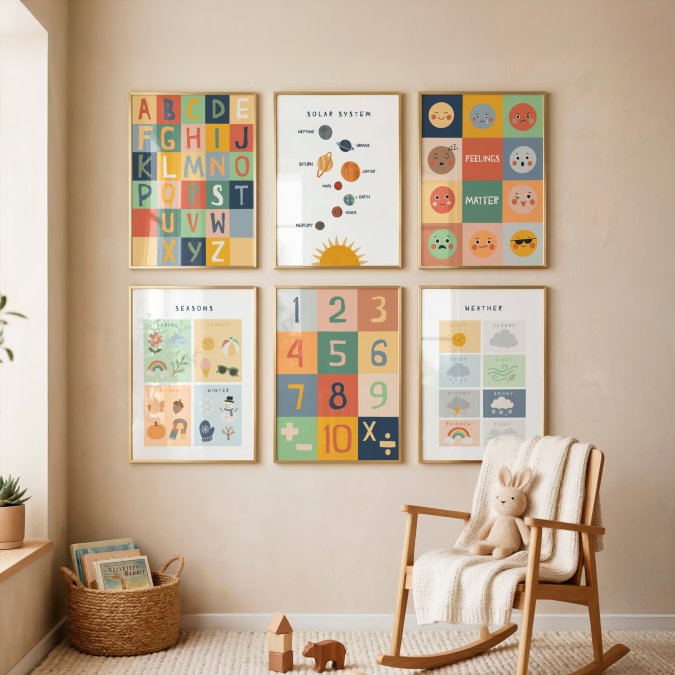
Toddler-accessible art shifts from something to look at to something to use. Alphabet, number, colour and weather posters hung at child height turn a wall into an interactive learning corner. A common mistake is buying for the baby stage only, then replacing the whole wall at two, choosing pieces with lasting educational value avoids that waste.

Why Low Hanging Nursery Art Builds Independence
Low hanging nursery art builds independence because it puts learning within a child's reach instead of above their head. When a toddler can walk over, point at a picture and name it without an adult lifting them, the wall becomes part of their world rather than yours.
How to Create a Gallery Wall for Kids
Creating a gallery wall for kids means planning heights, spacing and hanging methods around your child rather than a magazine layout. Get it right and the wall stays safe and useful for years.
Planning the Layout and Heights
Start by deciding the wall's job: a learning wall of alphabet, number and colour posters suits a play corner, while one or two calming pieces suit the sleep zone. Lay frames out on the floor first, or tape paper templates to the wall, so you can check the arrangement before committing to nails.
Choosing Frames and Safe Hanging Methods
Safety decides the hardware. Lightweight frames with acrylic rather than glass are the sensible default in a child's room. Use two hooks per frame for anything wider than a hand span, and fix into a stud or proper wall anchors rather than a single small nail. For renters, removable adhesive strips work for lightweight prints, though not heavier frames or textured walls.
Choosing Materials, Colours and Themes
Natural materials and a restrained palette do more for a calm environment than any single print. Material choice is not only aesthetic, it determines how a piece behaves over years of dust, sunlight and small hands.
Materials that survive a nursery
Look for matte paper stocks, timber or bamboo frames, and cotton or linen textiles nearby, textures that soften a room in a way plastic and glossy finishes cannot. Each material has a trade-off worth knowing before you buy:
- Matte paper reduces glare, which matters when a print sits opposite a window or a night light. It also shows fingerprints less than gloss, though it can mark if wiped with a wet cloth.
- Timber and bamboo frames are lighter than metal or thick composite, which makes them safer at child height and easier to hang with removable strips. They can, however, warp in humid rooms, so avoid hanging them directly above a humidifier or in a bathroom-adjacent nursery.
- Cotton and linen textiles, banners, fabric wall hangings, soft books mounted on the wall, are the most tactile option and the most appealing to a baby learning to reach. They are also the hardest to clean, which is the trade-off worth accepting consciously rather than discovering later.
- Felt and wool wall hangings are popular for texture but attract dust and can pill with handling. A lint roller used gently is usually enough for routine care.
Cleaning natural materials without ruining them
Dust, sunlight and sticky fingers all take a toll, but a few simple habits keep prints and frames looking sharp for years:
- Dust frames monthly with a dry microfibre cloth; avoid sprays directly on the print surface, which can leave residue or lift ink.
- Keep art out of direct sunlight, which fades inks over time. If a wall gets strong afternoon sun, rotate the pieces on it rather than leaving one exposed year-round.
- Wipe acrylic glazing with a barely damp cloth, never a soaking one. Water that seeps behind the glazing can stain the print.
- For fabric hangings, vacuum gently on the lowest setting with a brush attachment, or use a lint roller. Spot-clean only if the care label allows it, and test on a hidden corner first.
- For timber frames, a dry cloth is usually enough. Avoid oil-based polishes near a cot, as the residue can linger.
Colour and theme choices that age well
On colour, a minimalist aesthetic doesn't mean beige everything. A soft base with two or three accent colours gives you flexibility, so new pieces can join the wall later without clashing. Botanical themes, gentle animal illustrations and simple abstract designs all sit comfortably in this scheme.
Caring for Wall Art: Cleaning, Rotation and Long-Term Adaptability
- Dust frames monthly with a dry microfibre cloth; avoid sprays directly on the print surface
- Keep art out of direct sunlight, which fades inks over time
- Wipe acrylic glazing with a barely damp cloth, never a soaking one
- Rotate pieces every few months to refresh the wall and match your child's current interests
Art rotation also solves the "will this look babyish in two years" worry. If your pieces are chosen for lasting value rather than a single stage, you're rearranging rather than replacing. A gallery wall that shifts as your child grows costs far less than a full redo.
Budget-Friendly Ideas: DIY, Printables and Personalised Keepsakes
Budget-friendly wall decor doesn't mean settling for generic. Digital printables let you choose the artwork and control printing costs, and hand-drawn designs carry a warmth mass-produced prints often lack.
A simple DIY approach:
- Choose a digital print in the size you need
- Print on quality matte paper at a local print shop
- Frame in a lightweight, child-safe frame
- Hang at your child's eye level
Frequently Asked Questions
What makes nursery wall decor Montessori inspired?
Montessori inspired nursery wall decor follows a few clear principles: art is hung at child eye level so little ones can actually see it, imagery is realistic rather than cartoonish, and materials are natural and non-toxic. The space stays calm and uncluttered, with a few carefully chosen pieces instead of busy walls. This approach supports visual development and lets your child interact with their environment rather than just look at it from a distance.
How high should low hanging nursery art be positioned for a toddler?
Hang art so the centre of the piece sits roughly at your child's eye level, which for a standing toddler is about 60 to 70 centimetres from the floor. For a baby who is not yet standing, that means lower still, around 30 to 40 centimetres, so the art is visible during tummy time. The goal is a child-led environment where your little one can point at, name and reach toward the artwork without an adult lifting them.
How can I create a gallery wall for kids without it looking cluttered?
Start with a limited colour palette and a consistent frame style, then vary only the print sizes. Lay everything on the floor first and photograph the arrangement before you commit to nails. Keep the lowest row at child height so your toddler can engage with it, and leave generous space between frames. A calm environment comes from restraint, so aim for five to seven pieces rather than filling every gap.
Are personalised prints suitable for a Montessori nursery?
Yes, provided the design stays simple and realistic. A personalised print featuring your child's name, birth details or a hand-drawn illustration fits Montessori principles because it reflects your child's own story and grows more meaningful over time. Look for pieces printed on premium matte paper with non-toxic materials, and hang them low so your child can connect the artwork to themselves as they grow.
Decorating a nursery around your child's development takes more thought than filling a wall, but the payoff is a room that works harder and lasts longer. Little Lemons Art designs hand-drawn prints meant to grow with your little one, with personalised keepsakes, custom gallery wall design and both printed and digital options so you can build the wall at your own pace. Get started with Little Lemons Art and create a space your child can actually reach, use and grow into.